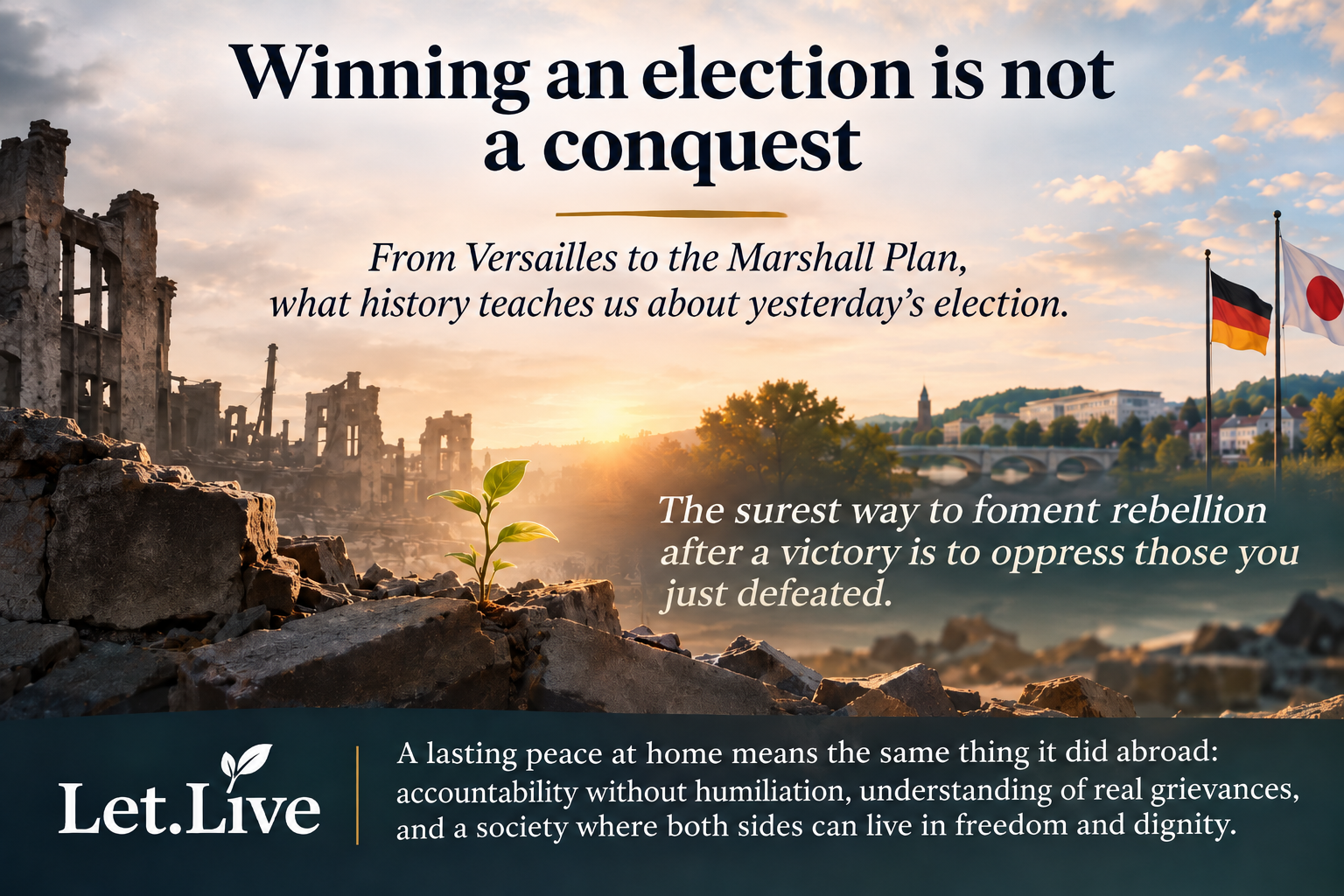
The lessons of Versailles, the Marshall Plan, and what America must learn from yesterday’s election.
Yesterday, American voters delivered a significant political victory to the Democratic Party. For Democrats, there is understandably much to celebrate. For Republicans, there is disappointment, anger, and perhaps a sense that the country they thought they understood has rejected them. But history offers a warning to every victorious political movement: the surest way to turn a defeated opponent into a future enemy is to humiliate him in victory.
Winning a war is one thing. Winning the peace is something else entirely. And if Americans want this election to represent something more than another turn of the wheel in an increasingly bitter political struggle, we would do well to remember the lessons of two world wars.
The Peace That Planted the Seeds of Another War
In 1918, the Allies defeated Germany in World War I. The war had killed millions, devastated Europe, and left an entire generation traumatized. The victorious powers had every reason to be angry. They had suffered enormously, and they wanted Germany to pay.
The Treaty of Versailles imposed territorial losses, military restrictions, and substantial reparations on Germany. The settlement also became a powerful symbol of national humiliation. But the treaty did not end German nationalism, resentment, or the grievances that had helped fuel the conflict. Instead, those grievances became fertile ground for political extremism.
Germany’s subsequent economic crises, the Great Depression, political violence, and the failures of the Weimar Republic all contributed to the rise of Adolf Hitler. Versailles was not the sole cause of Nazism, but Hitler skillfully exploited the humiliation associated with the treaty. He offered Germans a seductive promise: their suffering was someone else’s fault, their humiliation could be reversed, and their national greatness could be restored.
Within a generation, Europe was at war again. The victors of World War I had won the battlefield, but they had failed to establish a durable peace. There is a profound difference between holding a defeated government accountable and convincing an entire population that it has no honorable future. People who believe they have no place in the peace are susceptible to those who promise them another war.
The Peace That Turned Enemies Into Allies
After World War II, the United States faced a similar question. Germany and Japan had waged wars of aggression and committed terrible atrocities. Both had been comprehensively defeated, and the Allies could have pursued a future built entirely around punishment, permanent weakness, and national humiliation.
Instead, American policy evolved toward a different objective: building stable societies that could become peaceful partners. This did not mean ignoring wrongdoing. Nazi leaders were prosecuted at Nuremberg, Japan underwent sweeping political and institutional reforms, and both countries were occupied, disarmed, and subjected to substantial changes in their systems of government. But alongside accountability came reconstruction.
In Europe, the Marshall Plan helped rebuild shattered economies, restore trade, and create conditions in which democratic institutions could survive. Japan was not part of the Marshall Plan; its recovery came through American occupation policies, economic assistance, institutional reforms, and its eventual reintegration into the international economy. In both cases, the United States recognized something that the victors of World War I had struggled to achieve: a former enemy who has a stake in a peaceful future is more valuable than a permanently humiliated adversary.
The results were extraordinary. Germany and Japan, once among America’s most dangerous enemies, became two of its closest allies. This transformation was neither immediate nor inevitable. The Cold War, economic interests, domestic reformers, and many other forces shaped the outcome. But the essential lesson remains: the United States did not need Germans and Japanese to remain defeated forever. It needed them to become partners in a better future.
That is the difference between vengeance and statesmanship.
Democrats Have Just Won an Election, Not a Civil War
Yesterday’s election was not a military conflict, and Americans who voted differently are not enemy nations. That distinction matters, even though our political language increasingly resembles the language of warfare. We speak of crushing opponents, destroying political movements, punishing enemies, and taking revenge. We treat electoral victories as mandates not merely to govern, but to humiliate those who lost, and we increasingly describe our fellow citizens as existential threats rather than people with whom we disagree.
Democrats now face a choice about how to use their newly won congressional power. They can pursue accountability, exercise oversight, defend constitutional principles, and advance the policies on which they campaigned. Or they can allow the understandable satisfaction of victory to become a politics of collective retribution. There is nothing wrong with investigating misconduct, enforcing the law, or reversing policies that voters have rejected. Accountability is indispensable to a functioning republic. But accountability must be directed at actions, not identities.
A Republican voter is not guilty of every action taken by a Republican president, any more than a Democratic voter is responsible for every decision made by a Democratic administration. Millions of Americans supported Donald Trump for reasons that deserve to be understood, even by those who strongly disagree with their political choices. Millions opposed him because of concerns that deserve the same consideration. Neither population is going away, neither can be expelled from the American experiment, and neither can build a lasting peace by demanding that the other surrender its dignity.
Understanding Grievances Is Not the Same as Endorsing Them
One of the most damaging ideas in modern political discourse is that understanding an opponent’s grievances somehow legitimizes everything that opponent believes or does. It does not. We can acknowledge that many Americans feel economically abandoned without accepting every economic explanation offered by political leaders. We can recognize concerns about immigration, cultural change, government power, or declining trust in institutions without endorsing prejudice or abandoning constitutional protections. We can acknowledge fears about discrimination, authoritarianism, reproductive freedom, and democratic accountability without assuming that everyone who disagrees is motivated by hatred.
Understanding is not surrender. It is the beginning of problem-solving.
Republicans and Democrats often identify different causes for the country’s problems, but their underlying concerns are not always as different as their political rhetoric suggests. Both sides contain people who worry about whether their children will enjoy a better life, who distrust powerful institutions, who fear losing control over decisions that affect their families and communities, and who believe their fundamental freedoms are threatened. Both contain people who feel that the other side simply refuses to listen.
These grievances are not all equally supported by evidence, and some political demands are fundamentally incompatible. But dismissing concerns without examining them does nothing to resolve the conditions that give them political power. The question is not whether everyone can be made to agree. The question is whether we can construct a society in which disagreement does not require domination.
The Let.Live Principle: Your Freedom Does Not Require My Defeat
At Let.Live, we begin with a simple proposition: people should be free to live their own lives, according to their own values, so long as they respect the equal rights of others to do the same.
That principle is easy to embrace when the people exercising their freedom agree with us. Its real test comes when they do not. Can we defend freedom of speech for people whose opinions offend us? Can we respect religious liberty for people whose beliefs we reject, while also defending the freedom to reject religion entirely? Can we protect personal autonomy without demanding that everyone make the same personal choices? Can we tolerate lifestyles, traditions, and communities that we would never choose for ourselves?
And can we accept that our political opponents possess the same rights that we demand for ourselves?
If the answer is no, then we have not embraced liberty. We have merely embraced our own preferences. This is why tolerance is not simply a pleasant social virtue; it is a practical requirement for peaceful coexistence. A society in which every political victory gives one group the power to impose its entire worldview on another will never know lasting peace. Every election becomes an existential struggle because losing means surrendering control over one’s own life.
The solution is not to eliminate elections or pretend that political differences do not matter. It is to reduce the number of questions that require one side to conquer the other. The less power government has to dictate how peaceful people must live, the less terrifying it becomes when the other party wins control of that government.
That does not eliminate the need for laws, public institutions, or collective decisions. It does suggest that personal freedom, local autonomy, constitutional protections, and genuine tolerance can make political disagreement less destructive. We do not have to agree on the best way to live. We have to agree that we will allow one another to live.
What Would an American Marshall Plan Look Like?
America does not need foreign occupation, reconstruction from physical destruction, or a literal Marshall Plan. But we desperately need the kind of imagination that made the postwar settlement possible. Instead of asking how to make the defeated side pay, we should ask how to make both sides invested in the future.
That begins by addressing the conditions that produce resentment and alienation. If communities believe economic opportunity has disappeared, the answer cannot simply be to tell them that their grievances are imaginary. If people believe government institutions are unaccountable, the answer cannot be to demand unquestioning trust. If Americans fear that their rights depend entirely on which political party holds office, we should strengthen the protections that make those rights secure regardless of who wins.
If people feel culturally excluded, we should ask whether a pluralistic society can make room for their traditions without allowing those traditions to become compulsory for everyone else. And if people have been harmed by unlawful government actions, accountability and remedies must remain available without turning justice into collective punishment.
The goal should not be to manufacture ideological agreement. It should be to create conditions in which people can disagree without fearing for their freedom, safety, or future. That requires something much harder than winning an argument. It requires listening, compromise where compromise is possible, and principled protection of rights where it is not. It requires recognizing that a political opponent can be wrong about important things without being an enemy of the republic, and it requires the humility to acknowledge that our own side may be wrong about some things, too.
Peace Requires Something From the Defeated as Well
Reconciliation cannot be a one-way obligation. Republicans also have responsibilities following yesterday’s election. Respecting legitimate electoral outcomes, rejecting political violence, acknowledging wrongdoing, and accepting the constitutional authority of political opponents are essential parts of democratic life. A losing party cannot demand reconciliation while refusing to recognize the legitimacy of the process by which it lost, nor should calls for unity become an excuse to evade accountability.
The same standards must apply to Democrats when they lose. A peaceful republic requires that political movements recognize a distinction between losing power and losing their rights.
An election can determine who governs. It must not determine who belongs.
Preventing the Next War
The United States is not literally approaching a third world war because one political party lost a congressional election. But the analogy to the world wars offers a serious warning about the consequences of humiliation, grievance, and failed reconciliation.
Every cycle of retaliation creates the justification for the next. Every attempt to use temporary political power to permanently silence an opponent makes the next transfer of power more frightening. Every time we treat disagreement as evidence of moral inferiority, we make peaceful coexistence more difficult. Eventually, people stop believing that democratic institutions can resolve their differences.
The lesson of 1919 is not that defeated aggressors should escape responsibility, and the lesson of 1945 is not that peace requires forgetting atrocities. The lesson is that punishment alone cannot create a stable future. Justice must be accompanied by a path forward, accountability must leave room for reintegration, and victory must be followed by an effort to build a society in which yesterday’s opponents can participate with dignity.
Yesterday, Democrats won an election. What happens next will help determine whether that victory becomes another chapter in America’s escalating cycle of political retaliation, or an opportunity to begin something better.
At Let.Live, we believe the foundation of lasting peace is not the triumph of one worldview over another. It is the recognition that our neighbors have the same claim to liberty that we do. We do not need to convert Republicans into Democrats, or Democrats into Republicans. We need to find a way for both to remain Americans without requiring either to surrender the freedom to live according to their convictions, consistent with the equal rights of everyone else.
The greatest victory is not one that leaves your opponents powerless. It is one that leaves them with no reason to fear the peace.
Live your life. Let others live theirs. And build a country where neither requires defeating the other.
I also think this more traditional essay format better suits Let.Live. The historical narrative carries the argument, rather than relying on a succession of punchlines.
Comments are closed