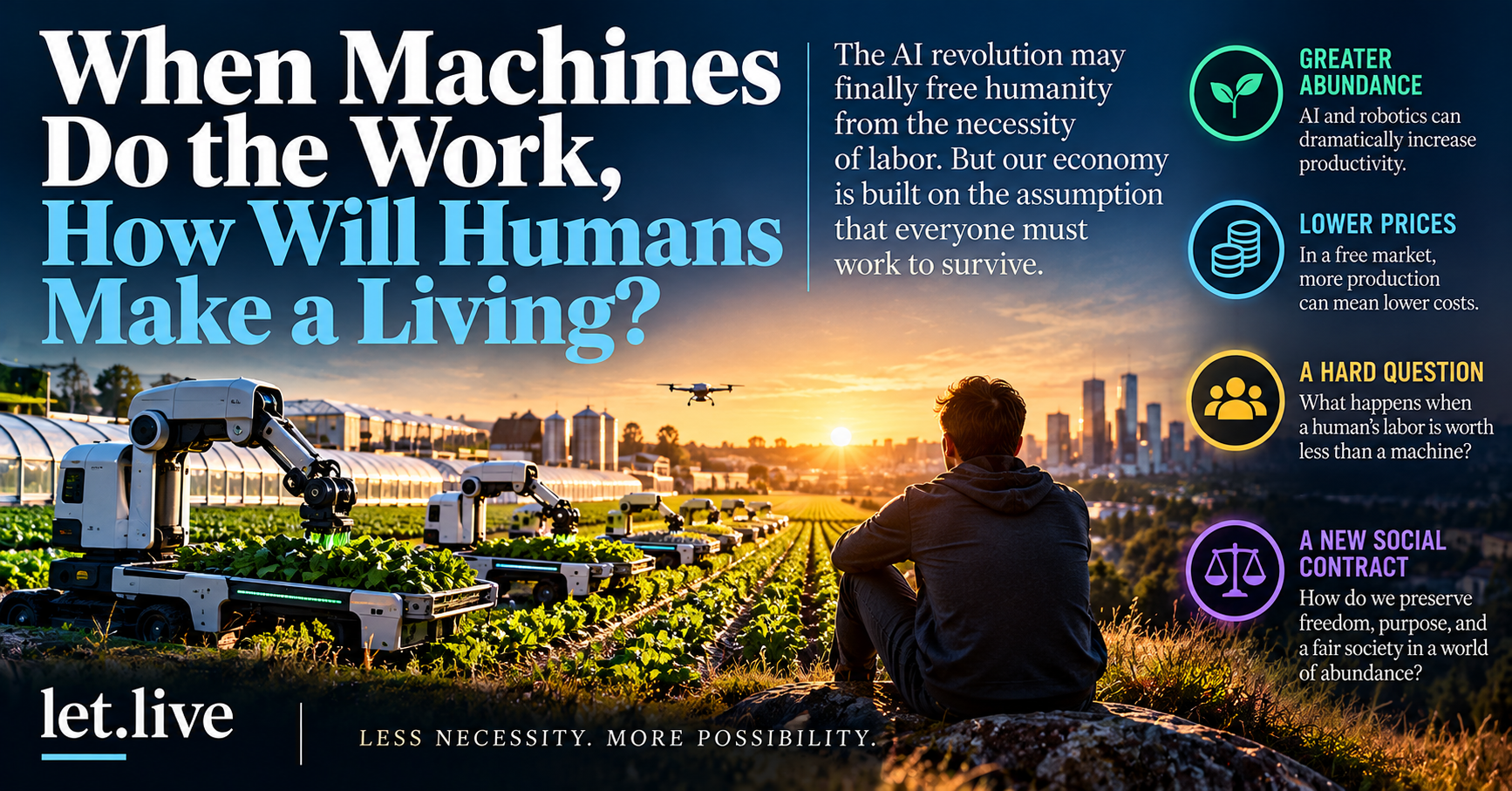
The AI revolution may finally free humanity from the necessity of labor. But our economy is built on the assumption that everyone must work to survive.
I believe the AI revolution may bring about something humanity has dreamed of for thousands of years: a world in which the necessities of life are so abundant that obtaining them no longer requires most of our time and effort. I’m not suggesting that everything will become free or that scarcity will literally disappear. There will always be things that are limited. But I suspect that within our lifetimes, artificial intelligence and robotics could make many of the things we need to survive extraordinarily inexpensive to produce.
A friend of mine is currently working on a completely automated farm, using AI and robotics to perform work that traditionally requires human labor. Their team anticipates productivity improvements exceeding 100% within five years. Whether that particular projection proves correct remains to be seen, but consider what it would mean if such improvements became common throughout agriculture.
In a competitive market, dramatic reductions in production costs create opportunities for lower prices, although the savings won’t necessarily flow directly or proportionally to consumers. Agriculture involves land, energy, transportation, distribution, and government policies that influence what producers grow and how markets operate. Nevertheless, increasing productivity has historically helped make food more affordable. The USDA has documented substantial agricultural productivity gains accompanied by declining inflation-adjusted agricultural output prices over the long term.
Now imagine similar technological improvements in manufacturing, construction, transportation, energy, healthcare, and software development. Imagine robots constructing homes, automated factories producing everyday goods, and intelligent machines performing services that once required years of specialized human training.
What happens to our economy when the amount of human labor necessary to produce the things we need begins approaching zero?
The Economic Bargain We’ve Always Made
In my earlier article, When Labor Is Worth Almost Nothing, I proposed a distinction between currency, value, and wealth. Currency is the medium we use to exchange things. Value describes the usefulness of those things. But our most precious personal wealth is something else entirely: our time and our health.
We spend our lives exchanging that wealth for currency. We work for eight hours, surrendering eight hours of our finite existence, and receive money in return. We then use that money to purchase food, shelter, transportation, and everything else we need or desire.
This arrangement makes sense in a world where human labor is necessary to produce those things. Society needs farmers, carpenters, electricians, physicians, engineers, and countless other workers. We compensate them because their labor creates something other people value.
But that arrangement contains an assumption so fundamental that we rarely stop to examine it: Human labor will always be economically valuable enough to exchange for the necessities of life.
What happens when that assumption stops being true?
When a Machine Is Worth More Than a Worker
Consider a farmer who once employed twenty people to plant, tend, and harvest crops. If automated machinery can accomplish the same work more reliably and at a fraction of the cost, the farmer has an economic incentive to adopt the machinery. That doesn’t mean the workers have become less valuable as human beings. It means the market value of the labor they previously supplied has declined.
We have seen versions of this throughout history. Tractors replaced enormous amounts of agricultural labor. Washing machines eliminated countless hours of domestic work. Computers automated calculations that once required rooms full of people. In each case, technology made human labor more productive or eliminated the need for particular tasks.
Historically, new industries and occupations have emerged as old ones disappeared. That may continue to happen. AI could complement workers, generate entirely new businesses, and increase demand for services we haven’t yet imagined. The International Monetary Fund has estimated that nearly 40% of global employment is exposed to AI, with some occupations benefiting from increased productivity and others facing displacement or reduced demand for labor.
But we should at least consider the possibility that this technological revolution is different in an important way. Previous machines generally replaced particular physical or intellectual tasks. AI, especially when combined with robotics, may eventually be capable of learning and performing an extraordinary range of tasks that humans currently do.
If machines can do nearly everything we can do, more cheaply than we can do it, what new occupation are we all supposed to move into?
A Problem of Distribution, Not Production
Here’s the paradox that concerns me. We could create a society capable of producing more food, housing, energy, and services than ever before, while simultaneously undermining the principal mechanism through which ordinary people obtain the currency necessary to purchase them.
Imagine a farm that produces twice as much food with almost no human labor. The farm’s owner might become considerably wealthier. Consumers might enjoy lower prices. But the workers whose labor is no longer required have lost their income.
Now imagine that happening across dozens of industries simultaneously. We could have an abundance of goods and services alongside millions of people who cannot afford them.
This isn’t because the goods lack value. It’s because the mechanism we use to distribute purchasing power still depends heavily on people selling their labor.
A society can become extraordinarily productive without automatically becoming extraordinarily prosperous for everyone in it. Who owns the machines, who receives their profits, how competitive markets remain, and how inexpensive essential goods become will all help determine whether abundance translates into broadly shared freedom.
A Conclusion That Pains Me
I need to be candid about something here. I am a true free-market evangelist. I believe deeply in voluntary exchange, private property, entrepreneurship, competition, and the extraordinary ability of free people to discover solutions that no central planner could possibly anticipate.
I don’t approach economic problems looking for opportunities to expand government. Quite the opposite. My instinct is to ask what government is doing to prevent people from solving problems themselves, and what would happen if we removed those obstacles.
That is why the conclusion I keep circling back to pains me.
I suspect we may eventually need something resembling Social Security for everyone.
Not necessarily Social Security as we know it today, and not necessarily a government check large enough to replace every working person’s salary. But some mechanism through which people receive purchasing power without having to demonstrate that their labor is economically necessary.
I don’t particularly want that conclusion to be true. A society in which everyone depends upon a government payment raises profound questions about liberty, autonomy, political power, and the relationship between citizens and the state. Whoever controls the distribution of essential income could acquire enormous influence over the people who depend on it.
But I also cannot dismiss a problem simply because the potential solutions offend my philosophical preferences. If I believe in free markets because they produce freedom and prosperity, I have to be willing to examine what happens when technological progress changes the assumptions upon which our current economic arrangements depend.
Being committed to liberty does not excuse me from confronting an uncomfortable question.
Could Free Markets Solve This Without Universal Income?
There are possibilities that deserve serious consideration before assuming a government-administered income is inevitable.
Perhaps the necessities of life will become so inexpensive that people can support themselves through a small amount of work. Perhaps AI and robotics will enable individuals to own highly productive businesses with almost no employees, spreading the ownership of productive capital far more widely than it is today. Perhaps people will increasingly receive income through investments, cooperatives, dividends, or other ownership arrangements rather than traditional wages.
There is also the possibility that automation will create new forms of work, or that human services will remain valuable precisely because people prefer dealing with other people. Some of these possibilities may coexist, and different industries may experience radically different transitions.
A universal basic income is another possibility, as are public dividends from collectively owned assets or targeted income supports. Each approach presents difficult questions about financing, incentives, ownership, and control. And none should be treated as a proven answer to an economic transformation whose ultimate scale we cannot yet know.
The question that matters to me is whether we can find arrangements that preserve individual choice rather than merely replacing dependence on an employer with dependence on a government agency.
The Difference Between Freedom From Work and Freedom to Live
There is a cultural problem here as well, and I suspect it may be just as difficult as the economic one.
We have spent generations teaching people that work gives their lives meaning. We ask children what they want to be when they grow up, and we expect an occupational answer. We ask strangers what they do, meaning what they do for a living. We praise hard work, admire professional accomplishment, and frequently measure personal success through income.
There is nothing inherently wrong with finding purpose in work. I have spent much of my life building things, solving problems, and enjoying the satisfaction that comes from creating something valuable.
But human beings are worth more than their economic output.
A person who spends an afternoon reading, caring for a child, helping a neighbor, creating art, enjoying nature, or simply being with someone they love has not wasted that afternoon merely because nobody paid them for it.
In fact, if we return to my earlier definition of wealth as time and health, a world in which people no longer need to sacrifice most of their waking hours to survive could be the wealthiest civilization humanity has ever known.
The challenge is learning to recognize that wealth without insisting that every person first justify their existence through paid labor.
Abundance Must Not Become Another Form of Dependence
This is where the future of AI intersects most directly with the principles of Let.Live.
A society in which machines perform nearly all necessary labor could be an extraordinary expansion of individual liberty. People might have more time for their families, communities, education, creativity, and personal ambitions. The economic pressure to remain in an abusive workplace, tolerate an exploitative employer, or sacrifice one’s health merely to survive could diminish enormously.
But the same technology could produce a very different society. If access to life’s necessities depends entirely upon a small number of corporations or a centralized government distribution system, technological abundance might coexist with profound personal dependence.
Neither private ownership nor public administration automatically resolves that danger. Competition, broad access to productive technology, the ability to own assets, transparent institutions, and protections for individual autonomy all matter. Any system of income support would also have to confront the danger of making basic survival contingent upon political approval or personal compliance.
We should be thinking about these questions now, while the future remains open, rather than waiting until technological change forces hurried decisions upon us.
The Question of Our Time
For thousands of years, human beings have struggled against scarcity. We have invented tools, developed agriculture, built machines, discovered new sources of energy, and organized increasingly sophisticated economies to make the necessities of life easier to obtain.
Now we may be approaching a world in which the machines we have created can shoulder much of that burden themselves.
I find that prospect enormously exciting. I also find it unsettling, because I don’t yet know how we will reconcile such abundance with an economic system built around the necessity of selling our labor.
Perhaps the answer will be universal income. Perhaps it will be broad ownership of productive machines. Perhaps the cost of living will fall so dramatically that the question of income becomes far less important. Perhaps we will discover an entirely new arrangement that nobody has yet imagined.
I am not ready to surrender my faith in free markets. But neither am I willing to insist that the answers of the past must remain the answers of the future.
The goal was never to make everyone work. The goal was to make it possible for everyone to live.
If machines can finally free us from the burden of labor, our challenge will be to ensure that we don’t exchange that burden for a new form of dependence.
Comments are closed