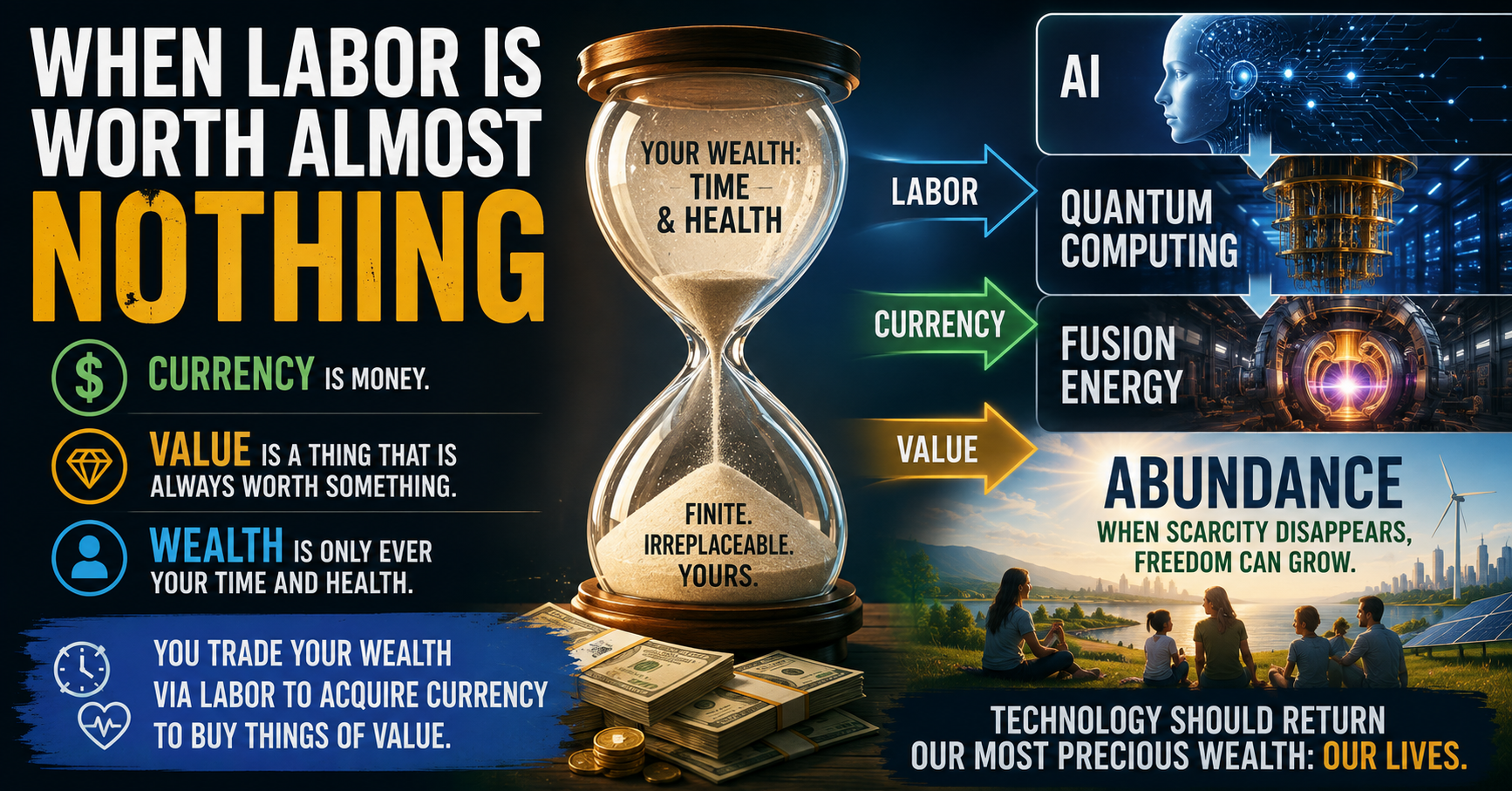
We use three words almost interchangeably that describe very different things: currency, value, and wealth.
Currency is a medium of exchange. Dollars, euros, pesos, Bitcoin—these are accounting systems that allow us to exchange things that are otherwise difficult to compare.
Value is different. Something has value because it can do something for us. Land has value because we can live on it, farm it, build on it, or simply enjoy it. Food has value because it sustains us. A gallon of gasoline has value because it can move a car a certain distance. Gold has unusual physical properties that make it useful, scarce, durable, and desirable.
And then there is wealth.
For purposes of this argument, I want to propose a much more personal definition of wealth:
Your wealth is your time and your health.
Everything else is something you possess.
You have only so many years. You have only so many healthy hours within those years. Every hour you spend doing something you don’t want to do is an hour of that finite supply exchanged for something else.
That makes labor one of the strangest transactions humans routinely make.
We trade our actual wealth—our finite time and some portion of our physical and mental health—for currency. We then use that currency to acquire things we value.
Seen this way, a paycheck is not wealth. It is compensation for wealth already spent.
Currency Lets Us Compare Things That Aren’t Comparable
Imagine three people. Dan is an excellent software engineer. Matt is an excellent comedian. Susan is an excellent plumber.
There is no natural unit with which to compare an hour of software engineering with an hour of comedy or an hour of plumbing. Currency solves that problem.
Perhaps the market decides an hour of Dan’s software engineering is worth $350, an hour of Matt’s comedy is worth $150, and an hour of Susan’s plumbing is worth $200.
That doesn’t mean Dan’s time is intrinsically more valuable than Matt’s or Susan’s. Each has surrendered exactly one irreplaceable hour of life.
It means the market currently places different values on what each person can produce during that hour.
This distinction matters because we have built most of modern civilization around exchanging human time for currency.
And something extraordinary may be about to happen to that arrangement.
What Happens When Intelligence Becomes Cheap?
Artificial intelligence is already reducing the amount of human labor required to perform certain intellectual tasks. We should be careful about extrapolating too confidently from today’s technology, but consider a thought experiment.
Suppose AI becomes dramatically more capable than it is today.
Then suppose AI helps solve practical quantum computing.
And suppose vastly greater computational power accelerates AI further, helping humanity solve extraordinarily difficult engineering problems—including commercially practical fusion energy.
None of those outcomes is guaranteed. Quantum computing does not automatically produce fusion, and AI does not magically eliminate the enormous physical and engineering challenges involved.
But imagine that eventually we get there.
Now combine extremely capable artificial intelligence, extraordinary computational capacity, robotics, and abundant energy.
What happens to the economic value of human labor?
It could fall enormously.
Not because humans have become less valuable.
Because human labor has become less scarce.
That distinction may become one of the most important distinctions of the next century.
The $5 Plumber
Suppose a robotic plumber can arrive at your house and replace a water heater for $20.
The robot doesn’t sleep. It doesn’t need health insurance. It doesn’t commute. It doesn’t need retirement savings. Its labor is powered by electricity that, in our hypothetical fusion economy, is extraordinarily inexpensive.
Susan can still replace your water heater.
But perhaps you’re now willing to pay her only $25 to do something a machine will do for $20.
Susan hasn’t become less worthy as a human being. Her time hasn’t become less precious to her.
The market value of her labor has fallen.
The same thing could happen to programmers, accountants, attorneys, radiologists, truck drivers, architects, musicians, writers and eventually almost every occupation.
This would create an apparent paradox.
Human labor could become nearly worthless at precisely the moment humanity becomes unimaginably rich.
We’ve Been Confusing Labor With Wealth
For thousands of years, scarcity forced human beings to work.
Food required labor. Shelter required labor. Clothing required labor. Transportation required labor. Energy required enormous amounts of labor and capital.
Civilization became progressively wealthier because technology allowed us to obtain more value from each hour of human effort.
A farmer with a tractor can produce vastly more food than a farmer with a hoe. We didn’t respond to the tractor by mourning the declining economic value of hoeing fields. We celebrated because fewer human hours were required to feed everyone.
AI may simply be the continuation of that process on an extraordinary scale.
If machines can eventually produce most of the things we value with very little human labor, then the declining value of labor isn’t necessarily a catastrophe.
It might be the objective.
The Great Economic Question
There is, however, an enormous problem between here and there.
Our society distributes purchasing power primarily through labor.
You work.
You receive currency.
You exchange the currency for things you value.
If the market value of human labor collapses while access to food, land, housing, energy, and other valuable things still requires currency, that chain breaks.
We could find ourselves in the peculiar situation of having unprecedented productive capacity while millions of people lack the currency necessary to purchase what that productive capacity creates.
That will create tremendous political pressure.
And this is where those of us who care about liberty need to start thinking now, rather than waiting until the crisis arrives.
Abundance Can Produce Authoritarianism Too
The obvious political response to widespread technological unemployment will be demands for government distribution.
Tax the machines. Tax AI. Nationalize energy. Guarantee incomes. Allocate housing. Control prices. Decide who receives what.
Perhaps some future policies along those lines will prove necessary. We should be humble enough to admit that nobody knows exactly what an economy with near-zero-cost intelligence and energy would look like.
But we should recognize the danger.
If government becomes the institution through which everyone receives the necessities of life, government acquires extraordinary power over everyone.
The technological path toward abundance could inadvertently become a political path toward dependence.
That would be a terrible irony.
Humanity would finally develop machines capable of freeing us from compulsory labor only to construct political institutions capable of controlling how we live without it.
The Libertarian Challenge
Libertarians have traditionally been very good at explaining how markets allocate scarce resources.
We may soon need to become equally good at explaining how liberty operates when important resources are no longer particularly scarce.
The objective should not be preserving jobs merely because people once performed them. Nobody should be required to dig a ditch with a shovel because employing twenty people is preferable to employing one person with an excavator.
The objective should be allowing technological abundance to translate into human freedom.
Remember our original definition of wealth.
Your wealth is your time and your health.
For most of human history, people have been forced by necessity to surrender enormous portions of both simply to remain alive.
Technology has gradually returned some of that wealth to us.
AI could return vastly more.
The Richest Generation in History
Imagine someone living in that future.
She works ten hours a week—or perhaps doesn’t need to work at all.
Energy costs almost nothing. Machines manufacture ordinary goods. Automated agriculture produces abundant food. AI provides education, entertainment, engineering assistance, medical analysis, and countless other services for negligible marginal cost.
Perhaps she possesses relatively little currency by today’s standards.
Is she poor?
Under our current accounting systems, perhaps.
But if she owns her days, enjoys good health, spends time with people she loves, creates things because she wants to create them, travels, learns, raises children, tends a garden, writes terrible poetry and occasionally spends an entire Tuesday doing absolutely nothing simply because she can, I would argue that she is extraordinarily wealthy.
Because she possesses the thing humanity has spent thousands of years trading away.
Her own time.
That may ultimately be the promise of artificial intelligence.
Not making everyone rich in dollars.
Making currency less important because fewer things require the sacrifice of human life to produce them.
And if we can navigate the transition without surrendering our autonomy to institutions promising to manage abundance for us, AI may accomplish something much more important than increasing productivity.
It may allow ordinary people to reclaim their wealth.
Not their money.
Their lives.
Comments are closed