Twice a year, Americans are reminded that changing our clocks is annoying. As a result, there is growing support for “ending Daylight Saving Time.” The problem is that people don’t actually agree on what that means.
Some want permanent Standard Time because it more closely aligns with our natural circadian rhythms and the position of the sun. Others want permanent Daylight Saving Time because they prefer having more daylight after work and school.
The truth is that we aren’t deciding whether to have more or less daylight—we’re deciding when we want it.
One hour on the clock simply moves an hour of sunlight from the morning to the evening.
The debate becomes much more interesting when you look at the actual consequences for major American cities.
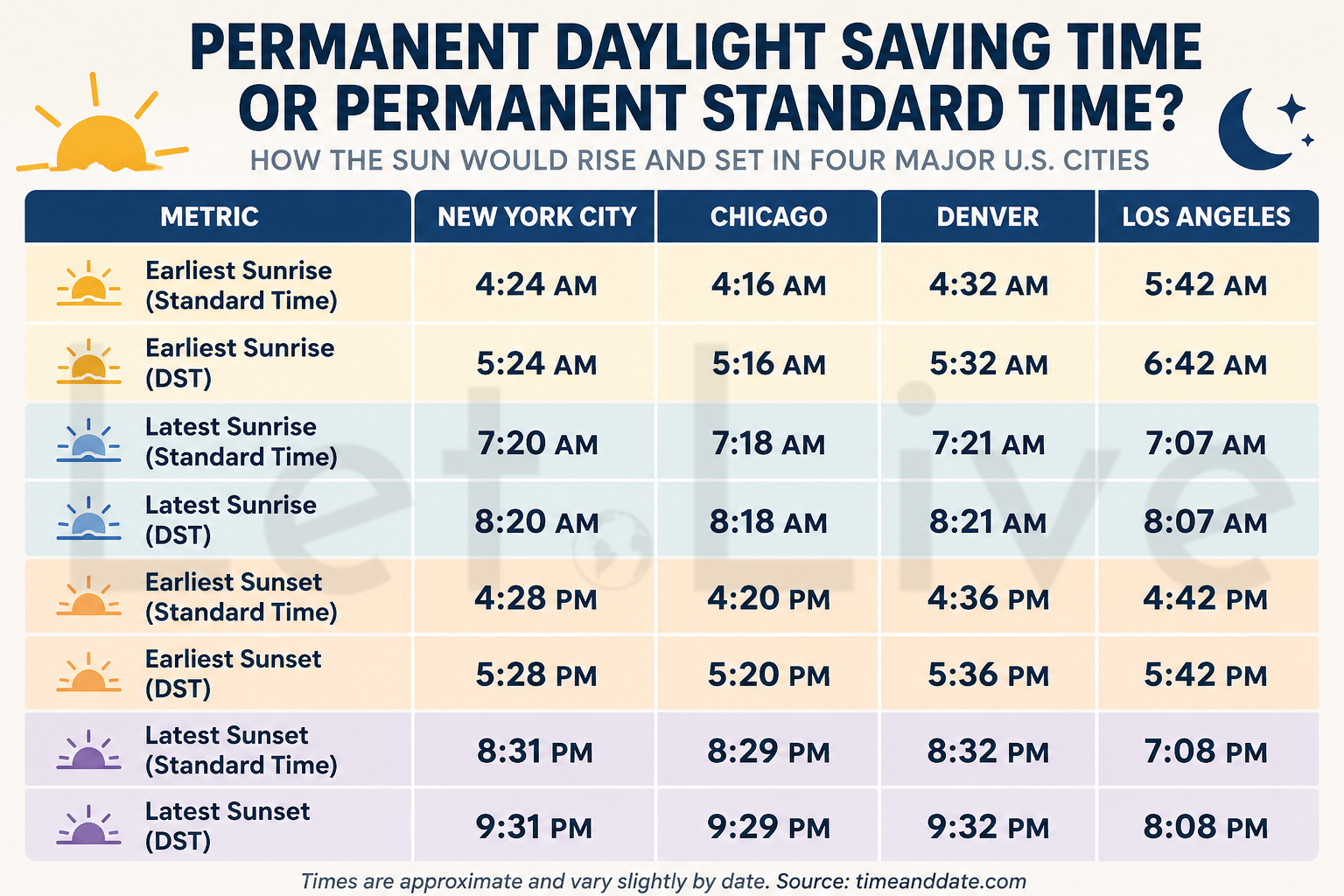
There are a few things that immediately jump out from this chart.
Chicago gets perhaps the most extreme summer sunrise under permanent Standard Time—4:16 AM. Most Americans simply aren’t awake to enjoy that extra hour of daylight.
On the other hand, permanent Daylight Saving Time pushes winter sunrises well past 8 AM in many cities. That means children waiting for school buses and workers commuting in darkness for weeks at a time.
What’s particularly interesting is that geography matters almost as much as the clock itself. Denver and New York have remarkably similar sunrise and sunset times despite being two time zones apart because both cities sit near the eastern edge of their respective time zones. Meanwhile, Los Angeles enjoys naturally later daylight because it sits farther west.
The farther north you live, the more dramatic these tradeoffs become. Minneapolis, for example, would experience an 8:51 AM sunrise under permanent Daylight Saving Time in early January—a difficult proposition for many people.
There are good arguments on both sides.
Supporters of permanent Standard Time point to sleep science and our biological clocks. Morning sunlight plays an important role in regulating sleep cycles, mood, and alertness. Standard Time also keeps solar noon—the time when the sun is highest in the sky—much closer to noon on our clocks.
Supporters of permanent Daylight Saving Time focus on quality of life. More evening daylight means more time for outdoor recreation, shopping, exercising, and simply enjoying the day after work. There’s a reason many people cheer when the clocks “spring forward” each year.
The reality is that neither side is wrong. They’re simply prioritizing different things.
Personally, I suspect most Americans would gladly trade a 4:16 AM sunrise in June for an extra hour of daylight in the evening. But I’m also sympathetic to the argument that an 8:20 AM sunrise in January isn’t exactly ideal either.
The sun doesn’t care what we call the time on our clocks. Congress can’t create or destroy daylight—it can only decide where to put it.
So perhaps the better question isn’t whether we should abolish Daylight Saving Time. It’s this:
If we’re only allowed to choose one clock for the entire year, when would you rather have your sunshine?
Comments are closed