The current fight over White House press access raises serious constitutional questions. President Donald Trump has barred CNN, MS NOW, and Politico journalists from the White House after accusing the organizations of false reporting. The organizations have sued, arguing that the government cannot grant press access and then withdraw it because officials dislike an outlet’s coverage. The White House argues that the First Amendment protects publication but does not entitle a particular organization to a White House hard pass, briefing-room seat, or pool position.
Those questions will ultimately have to be resolved through our legal system. But perhaps this controversy should also cause us to ask a different question: Why are we still conducting White House press briefings this way at all?
We have a room full of reporters trying to get recognized by a government official. The press secretary decides whom to call upon. Reporters sometimes shout questions. Certain organizations traditionally receive more opportunities than others. Personal relationships inevitably develop between government officials and the journalists who cover them. That’s an enormous amount of human discretion built into a process whose entire purpose is supposed to be getting information from the government to the American people.
Technology gives us an opportunity to remove much of that discretion.
Put a Camera in the Room
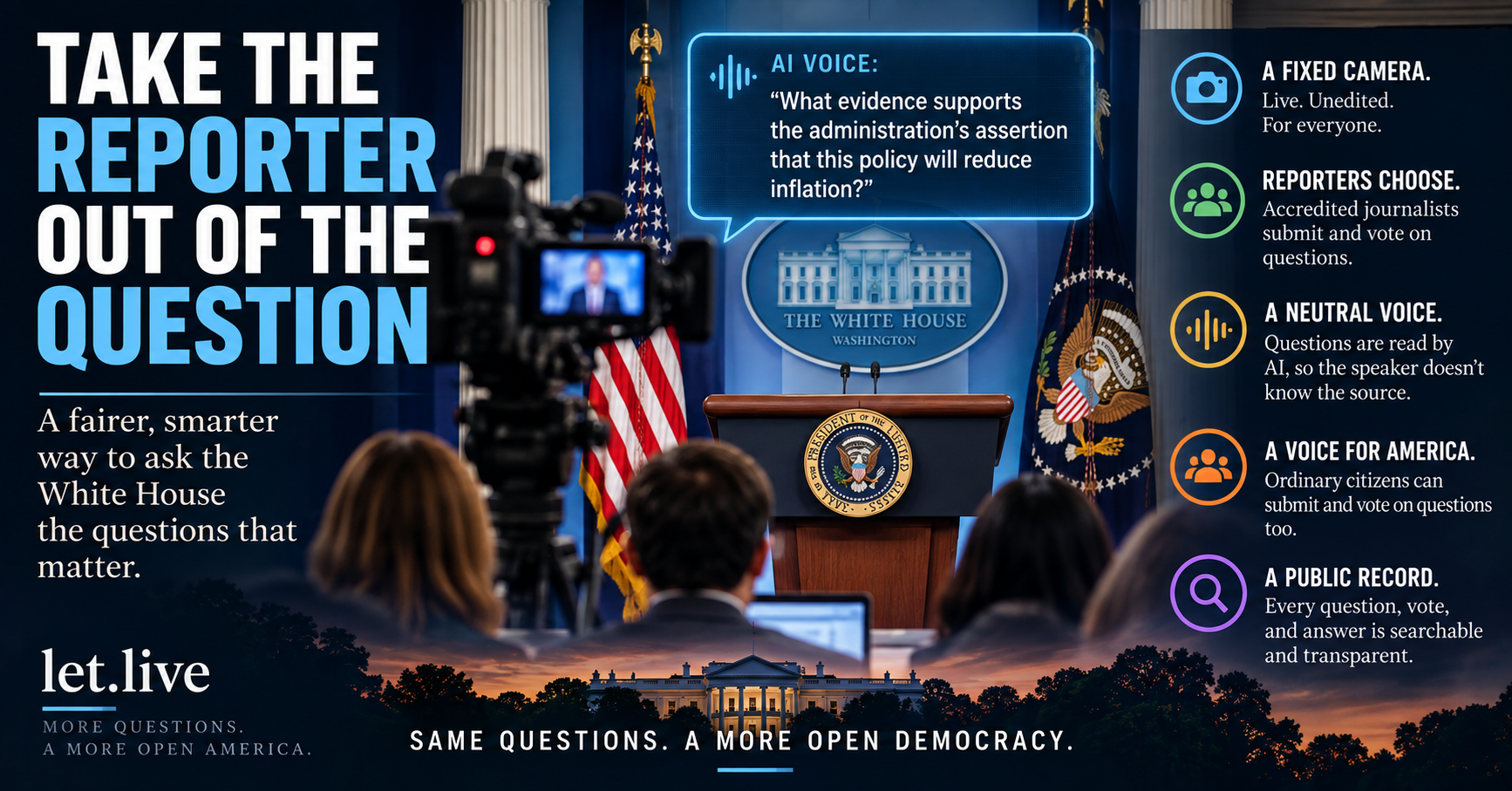
Imagine a different White House briefing. There is a fixed camera pointed at the lectern, and its feed is publicly available, live and unedited. Accredited members of the White House press pool submit questions electronically, and the journalists themselves vote on which question should be asked next.
The winning question is sent to a text-to-speech system using an ordinary, neutral synthetic voice. The official at the lectern might hear, “What evidence supports the administration’s assertion that this policy will reduce inflation?” The official answers, the next question is selected, and the process continues.
Most importantly, the official doesn’t know whether the question came from Fox News, CNN, Reuters, Politico, the New York Post, MS NOW, or an independent journalist. There is no reporter standing there to reward and no reporter standing there to punish.
There is only the question.
Make the Question Stand on Its Own
That would change an important psychological dynamic. Today, an official doesn’t merely hear a question; the official sees the person asking it. That person has a history. Their organization has a reputation. Perhaps the official likes that organization or despises it. Perhaps the reporter wrote something favorable yesterday or published something devastating last month.
All of that information enters the conversation before the question has even been answered. Remove the reporter’s identity, and something interesting happens: a good question from a hostile publication becomes simply a good question, while a bad question from a friendly publication becomes simply a bad question.
Judge the question rather than the questioner.
This doesn’t guarantee better answers. A politician can still evade a question, spin an answer, or challenge its premise. But it eliminates one completely unnecessary source of bias: the identity of the person asking it.
Let the Press Choose the Questions
There is another strange feature of the current system worth reconsidering. Why should the government decide which journalist gets to question the government?
The existing White House press pool already operates on the principle of collective representation. When physical space is limited, a smaller group of journalists observes events on behalf of the larger press corps and distributes what it sees and hears. The White House Correspondents’ Association describes pool reporters as the “eyes and ears” of the broader press corps.
We could apply that same principle to questions. Let participating journalists submit them and then let participating journalists decide which questions are most important. The government doesn’t choose the journalist. The president doesn’t choose the journalist. The press secretary doesn’t choose the journalist. No single media corporation gets to monopolize the conversation.
The press collectively determines what it believes the government most needs to answer.
That system wouldn’t be perfect either. A majority of reporters could share the same assumptions or overlook an important minority viewpoint. Rules would have to prevent one organization from flooding the vote with participants. But those are engineering and governance problems that can be addressed transparently. More importantly, the selection of questions would no longer be controlled by the institution being questioned.
Keep Journalists in the Room
None of this means replacing journalists with cameras. Independent human observers remain enormously important. Cameras don’t notice everything, and a government-controlled camera certainly shouldn’t become the only record of government activity.
Pool reporters should continue physically observing the president and other officials when appropriate. Journalists provide context, identify people entering and leaving meetings, observe reactions, compare statements with previous ones, pursue sources, investigate documents, and report things that an official camera may never show. That “eyes and ears” function is fundamentally different from deciding who gets to ask the next question.
Keep the journalists. Keep independent cameras and photographers. Keep adversarial reporting.
Automate the unnecessary gatekeeping.
Then Open a Door to America
Once the infrastructure exists, there is another fascinating possibility: give ordinary Americans some access to it.
Millions of simultaneous questions would obviously be impossible to handle individually, but technology is extraordinarily good at organizing large quantities of information. Americans could submit questions through a public system. AI could identify thousands of substantially identical questions, group them together, remove duplicates, translate them where necessary, and organize them by subject.
AI should not decide which questions Americans are allowed to ask. That would merely replace one gatekeeper with another, potentially much less transparent one. Let people make that decision. Citizens could vote on questions, with appropriate safeguards against manipulation, and the highest-supported questions could periodically enter the White House briefing queue alongside those submitted by professional journalists.
Imagine the president or press secretary hearing a neutral synthetic voice say, “This question was submitted in 14,218 substantially similar forms by Americans in 43 states,” followed by the question itself.
No television personality is attached to it. No shouting match is necessary. No partisan branding precedes it. It is simply an American asking their government a question.
There is even an opportunity for systems like ChatGPT and other conversational AI services to participate at the edges of this process—not by deciding what government should be asked, but by helping ordinary people formulate questions, locate supporting evidence, identify duplicated concerns, and understand the answers afterward. The technology can organize the conversation without owning it.
Make Everything Auditable
Transparency would be essential. Every submitted press question could eventually become part of a searchable public record, along with its vote count, whether it was selected, and the government’s answer. The same could be done with questions submitted by the public, subject to reasonable protections against publishing personal information, threats, spam, or other inappropriate material.
That creates another useful form of accountability. Americans could see not only what the government was asked, but what it wasn’t asked. Researchers could examine which subjects the press considered important. Journalists outside the White House pool could see unanswered questions and pursue them independently.
Technology would therefore create more information rather than less.
The Government Doesn’t Need to Like the Questioner
The current White House controversy is ultimately about access and power. The administration believes particular news organizations have behaved badly enough to lose access; those organizations argue that excluding journalists because of their coverage amounts to unconstitutional viewpoint discrimination.
There is a broader institutional lesson available regardless of how that particular legal dispute is resolved. A president shouldn’t need to like CNN. A president shouldn’t need to like Fox News. A president shouldn’t need to like any journalist. Likewise, journalists shouldn’t need to cultivate favor with government officials merely to have an opportunity to ask important questions.
The question should have to stand on its own.
That is especially important because nobody involved is infallible. Presidents can be wrong. Press secretaries can be wrong. CNN can be wrong. Fox News can be wrong. The New York Times can be wrong. A room full of reporters can collectively be wrong. The answer isn’t to find an institution we can finally trust to always make the correct decision. Such an institution doesn’t exist.
The better answer is to build systems that assume human beings are fallible.
Less Power Is Usually Better Than Better People
When institutions fail, our instinct is often to search for better people to operate them. Find a fairer press secretary. Find more responsible journalists. Find a president who respects the press. Those things certainly matter, but they leave the underlying power exactly where it was.
There is another solution: design systems that require less discretion in the first place.
That principle extends far beyond White House press briefings. If the fairness of an institution depends entirely upon having a good person controlling it, we have designed a fragile institution. Eventually someone we don’t trust will occupy the chair, inherit exactly the same authority, and discover that all the powers accumulated by their well-intentioned predecessors work just as effectively for purposes those predecessors never imagined.
A more durable approach is to ask whether the power needs to exist at all.
Let journalists observe government, investigate it, criticize it, and submit questions. Let the press collectively decide which questions deserve answers. Let ordinary Americans participate too. Let technology strip away some of the personalities, affiliations, grudges, friendships, shouting, and theater that have accumulated around what ought to be a very simple democratic transaction.
Put a camera in the room. Turn on the microphone.
Ask the question.
And let America hear the answer.
Comments are closed