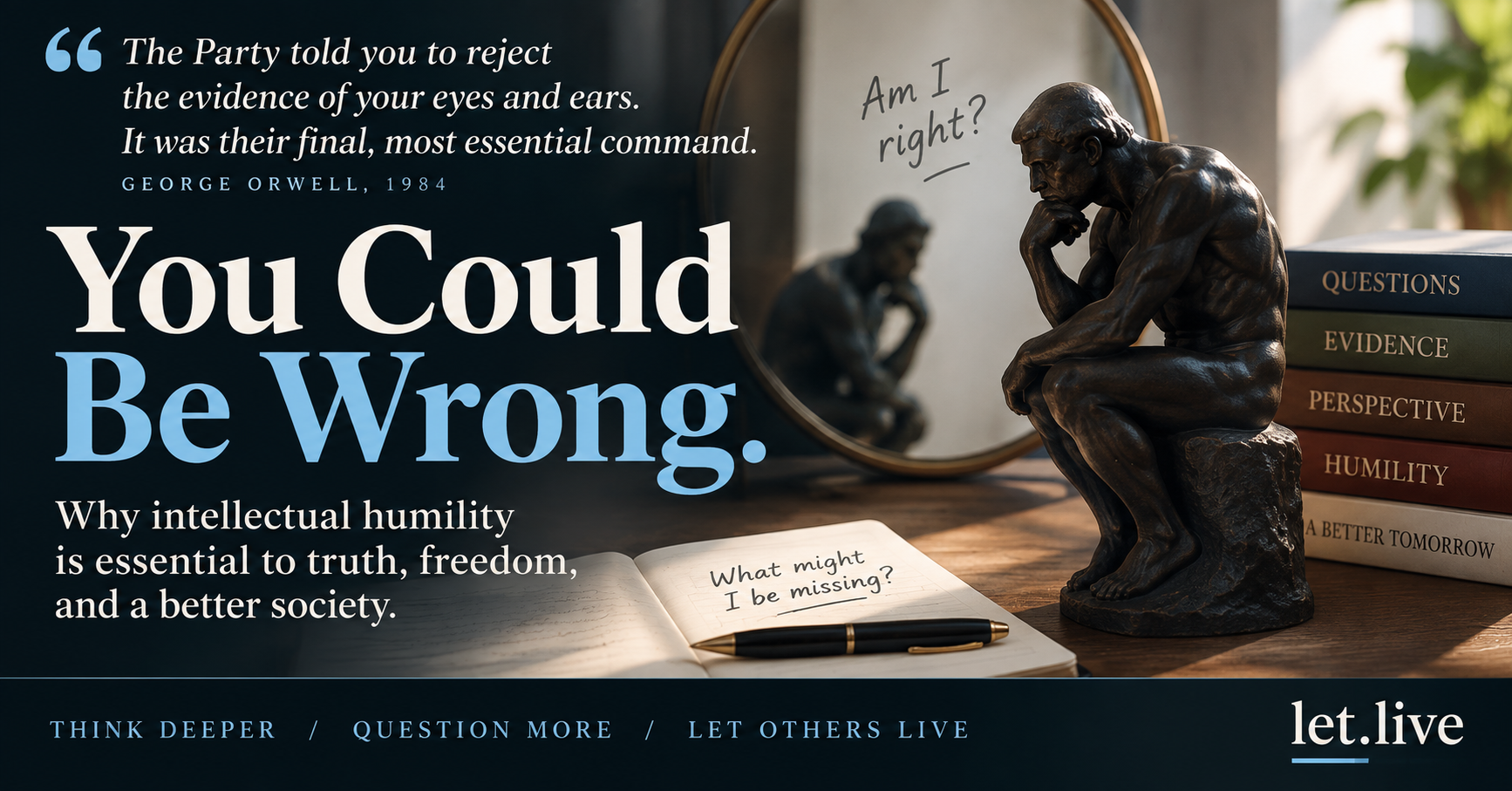
George Orwell wrote one of the most chilling sentences in 1984:
“The Party told you to reject the evidence of your eyes and ears. It was their final, most essential command.”
There is an obvious warning here, and sadly we see it played out in our daily news cycle.
But there is another danger that doesn’t require a Party, a dictator, or even a government.
You could be wrong.
So could I.
Worse, either of us could be wrong and have absolutely no idea that we’re wrong.
That may be one of the most important truths a person can learn.
Knowing Enough to Know You Don’t Know
The Dunning–Kruger effect has become something of an Internet cliché, usually invoked to explain why someone we disagree with is too stupid to understand how stupid they are. That use of the idea is itself almost comically contrary to the lesson we ought to take from it.
The important question isn’t whether the other guy is suffering from Dunning–Kruger.
It’s whether I am.
Competence should bring with it an appreciation for complexity. The more deeply you understand almost any serious subject, the more exceptions, qualifications, uncertainties, and unanswered questions you discover.
The novice says, “Obviously.” The expert is more likely to say, “It depends.”
That doesn’t mean knowledgeable people never reach strong conclusions. They do. It means that a thoughtful person understands something critically important about even their strongest conclusions:
I could be wrong.
Truth Is Not the Same Thing as Being Right
There is an enormous difference between wanting to know the truth and wanting to be right.
If my objective is to be right, contradictory evidence is my enemy. I need to defeat it, explain it away, discredit its source, or avoid looking at it altogether.
If my objective is truth, contradictory evidence is extraordinarily valuable.
It may be telling me that something I believe is wrong.
That makes the person challenging me useful.
Someone who demonstrates that I’m wrong hasn’t taken something from me. They’ve given me something. I entered the conversation believing something false and left believing something closer to the truth.
I won.
This is why people genuinely concerned about truth spend so much time attacking their own arguments.
They ask:
What would prove me wrong?
What evidence am I ignoring?
What assumption have I made without realizing it?
Am I treating evidence differently because it supports what I already believe?
Would I accept this argument if someone from the other political party made it?
Have I actually listened to the strongest argument against my position?
These aren’t signs of weakness.
They are intellectual quality control.
Judaism, Christianity, and the Obligation to Seek Truth
This idea has very deep roots in both Judaism and Christianity.
The Hebrew Bible repeatedly demands truthfulness. False witness is explicitly prohibited. Honest weights and measures are commanded. Again and again, the prophets challenge kings, priests, and entire societies when accepted wisdom has departed from what is right.
There is something profoundly important in those stories: authority does not determine truth.
Nathan can tell King David that David is wrong.
Elijah can confront Ahab.
Jeremiah can tell almost everyone around him something they don’t want to hear.
The king cannot make something true simply by commanding people to believe it.
Christianity inherits this tradition and makes the connection between truth and liberty explicit. In the Gospel of John, Jesus says, “you will know the truth, and the truth will set you free.”
But both traditions also contain another essential idea: human beings are fallible.
That changes the pursuit of truth considerably.
If I am fallible, then seeking truth cannot consist merely of identifying everyone else’s falsehoods.
I must examine my own.
Your Political Opponents Aren’t the Test
It’s easy to identify lies told by people we already dislike.
Republicans can find Democratic hypocrisy. Democrats can find Republican hypocrisy. Atheists can identify contradictions among religious people. Religious people can identify inconsistencies among atheists.
None of this demonstrates much intellectual courage.
The real test is finding the weakness in an argument you desperately want to be true.
Can you recognize when someone you voted for is lying?
Can you acknowledge evidence that helps the political party you oppose?
Can you discover that a person you dislike was nevertheless right?
Can you say, without qualification or embarrassment:
“I was wrong.”
Those may be three of the most liberating words in the English language.
Because once you’re comfortable saying them, you no longer have to defend every stupid thing you’ve ever believed.
You can simply learn.
Challenge Your Own Assertions
This should change how we argue.
Before demanding that someone else defend an assertion, try attacking your own.
If you believe a government program works, go looking for evidence that it doesn’t.
If you believe a politician committed wrongdoing, deliberately read the best defense of that politician.
If you believe a scientific claim, find out what its strongest critics actually argue—not what people on your side say the critics argue.
If you believe a news story, look for the primary source.
If a video confirms everything you already believed, become more suspicious of your reaction to it, not less.
The purpose isn’t to become incapable of reaching conclusions.
It’s exactly the opposite.
It is how we develop conclusions sturdy enough to survive examination.
This Is What Orwell’s Party Could Not Permit
This brings us back to Orwell.
The Party’s ultimate demand wasn’t simply that people believe lies.
It demanded that people surrender the process by which they determined what was true.
That’s much more powerful.
An intellectually independent person can be deceived. Every one of us can.
But an intellectually independent person remains dangerous to authoritarianism because tomorrow they might discover the deception.
They might look again.
They might ask another question.
They might compare sources.
They might notice that the explanation doesn’t fit the evidence.
They might say:
“Wait. I think I was wrong.”
A system dependent upon unquestioning loyalty cannot tolerate that sentence.
Intellectual Humility Is a Form of Liberty
At Let.Live, we talk about consent, tolerance, autonomy, and limits on coercive power. But all of those depend upon something even more fundamental: people capable of thinking for themselves.
Thinking for yourself does not mean stubbornly refusing to change your mind.
Quite the opposite.
The person who cannot change their mind isn’t necessarily independent. They may simply be imprisoned by their previous opinion.
Real intellectual freedom means retaining ownership over your beliefs.
No government owns them.
No political party owns them.
No religion owns them.
No activist movement owns them.
No newspaper owns them.
No social-media tribe owns them.
And neither does the person you were yesterday.
You are allowed to reconsider.
The Most Important Person to Question
We should question government. We should question corporations. We should question journalists, politicians, academics, religious leaders, activists, scientists, and anyone else claiming authority.
But there is one person whose assertions deserve particularly relentless scrutiny.
Your own.
Believe your eyes and ears.
Then investigate what you saw.
Seek evidence.
Listen to people who disagree.
Try to destroy your own argument.
And when it survives, believe it with confidence—but never with the arrogance of believing it could not possibly be wrong.
The pursuit of truth requires something more difficult than skepticism of authority.
It requires skepticism of ourselves.
Because the goal was never to be right.
The goal is to become less wrong.
Comments are closed