Most people understand that higher interest rates make mortgages, car loans, and credit cards more expensive. But that description almost makes interest sound like an extra fee banks tack onto borrowing. There is a simpler way to understand it.
Interest is the LITERAL price of money.
More precisely, it is the price you pay for the use of somebody else’s money for a period of time. When you borrow $200,000 to buy a house, somebody else gives up the ability to use that $200,000 today. In exchange, you promise to return the money over time and pay something for the privilege of using it in the meantime.
That something is interest.
Once you understand interest as a price, a great deal about mortgages, bonds, government debt, inflation, and monetary policy becomes easier to understand.
What Does a $200,000 House Really Cost?
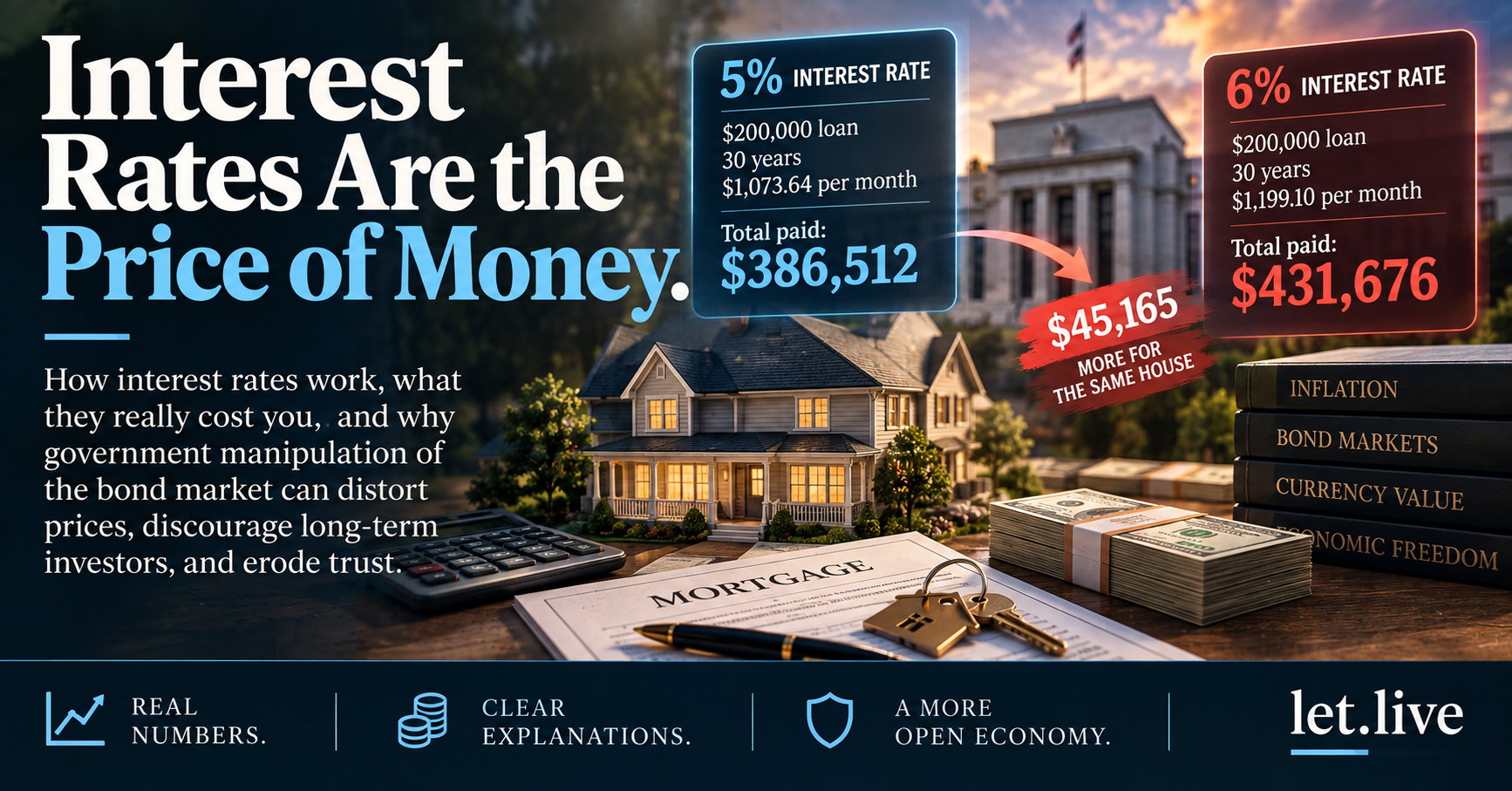
Imagine buying a $200,000 house with a 30-year fixed-rate mortgage at 5%. To keep the example simple, assume you finance the entire $200,000 and ignore taxes, insurance, closing costs, HOA fees, and other expenses.
Your monthly principal-and-interest payment would be approximately $1,073.64.
You make 12 payments a year for 30 years, which means you make 360 payments:
$1,073.64 × 360 = $386,510.40
Rounding differences aside, the precise amortization calculation comes to about $386,512.
So the $200,000 house ultimately requires about $386,512 in mortgage payments. Roughly $200,000 repays the principal you borrowed and another $186,512 is the price of borrowing that money over 30 years.
Now change only one number.
Instead of borrowing at 5%, borrow the same $200,000 for the same 30 years at 6%.
Your payment rises to approximately $1,199.10 per month.
Multiply that by 360 payments:
$1,199.10 × 360 = $431,676
The house didn’t get any bigger. The kitchen didn’t get nicer. The neighborhood didn’t improve. You didn’t get another bedroom. Yet the total mortgage payments increased by roughly $45,165. What became more expensive??
The money.
Money Has a Rental Price
We intuitively understand this concept with almost everything else.
If I own an excavator and you want to use it for six months, I charge you rent. If I own a house and you want to live in it for a year, I charge you rent. You are compensating me because I own something useful and am temporarily surrendering my ability to use it.
Money works similarly.
If I have $200,000 and lend it to you for 30 years, I surrender all the other things I could have done with that money. I could have bought property, invested in a business, purchased bonds, held it for emergencies, or invested it somewhere else.
I also accept risk. Perhaps inflation reduces what those future dollars can buy. Perhaps you don’t repay me. Perhaps interest rates rise after I lend you the money and I discover that I could have earned a better return somewhere else.
Interest compensates lenders for time, opportunity cost, inflation expectations, and risk.
Government bonds demonstrate this particularly clearly. When an investor buys a Treasury bond, the investor is lending money to the federal government. The yield is the return investors demand for making that loan. Government securities are also enormously important to the rest of finance because their yields help establish reference prices throughout financial markets. The IMF notes that government securities are widely used as collateral and to guide pricing in other financial transactions.
Price Is Not the Same Thing as Value
There is another distinction that becomes important here. Interest rates affect the price of borrowing money. Inflation affects the value of the money being borrowed.
Suppose you have $100 in your wallet and $100 will buy twenty $5 lunches. If, years later, those same lunches cost $10, the number printed on your money hasn’t changed. You still have $100. But its purchasing power has been cut in half: it now buys only ten lunches.
That is what we mean when we say inflation erodes the value of money. The Federal Reserve describes inflation as a general increase in the prices of goods and services, and acknowledges that high inflation rapidly erodes money’s purchasing power.
Money creation enters this story as well, although the familiar phrase “printing money” oversimplifies what actually happens in a modern monetary system. Creating additional money does not automatically produce an identical increase in prices. The relationship depends on how much of that money enters the broader economy, how quickly it circulates, how much the economy is producing, expectations about future inflation, and many other factors.
But the basic constraint is real. If the quantity of money and spending power persistently grows much faster than the economy’s ability to produce goods and services, more dollars are competing for the available output. Over time, that can produce inflation and reduce the purchasing power of each dollar.
This gives government two very different levers involving money. Through monetary policy and financial markets, government institutions can influence the price of borrowing dollars. Through monetary policy, they can also influence the purchasing power of the dollars themselves.
Those two things are connected. A lender agreeing to be repaid 10, 20, or 30 years from now cares deeply about what those future dollars will actually buy. If investors begin to believe that the currency will lose purchasing power faster than expected, they will generally demand greater compensation for lending it. Inflation expectations therefore become one of the things embedded in long-term interest rates.
In other words, attempts to make money cheaper to borrow can eventually make lenders demand a higher price for it if they become worried about what the money they receive back will be worth.
The Price of Money Changes Other Prices
Now we can understand why interest rates are so powerful.
Suppose a developer is considering building an apartment building. The project requires $50 million of borrowed capital. At one interest rate, the project may be profitable. At a substantially higher rate, it may not be.
The same calculation happens throughout the economy. A family decides whether it can afford a house. A restaurant decides whether to open another location. A manufacturer decides whether to build a factory. An entrepreneur decides whether to launch a company.
The price of money becomes part of the price of almost everything that requires financing.
That is why the Federal Reserve’s interest-rate decisions matter so much. The Fed directly influences the federal funds rate—the overnight rate at which banks lend reserve balances to one another—and changes in that rate flow into other short-term rates and ultimately affect household and business decisions.
But the Fed does not simply dictate every interest rate in America. Longer-term rates also contain information about expected inflation, economic growth, future interest rates, and the compensation investors demand for uncertainty.
That distinction becomes very important when we get to government bonds.
The Bond Market Is Talking
A bond yield isn’t merely a number on CNBC.
It is a price emerging from millions of decisions about time, inflation, opportunity, risk, government finances, and competing investments.
When investors demand a higher yield to lend the government money for ten or thirty years, they may be saying that they expect higher inflation, that other investments have become more attractive, that uncertainty has increased, or that they require greater compensation for locking up money for a long time.
The IMF describes this additional compensation for uncertainty as the term premium. Government bond yields therefore contain information about what investors collectively believe about future economic conditions and risks.
That doesn’t mean markets are always right. They aren’t.
It means prices contain information.
And governments should be extremely careful about interfering with the information contained in prices.
What Happens When Government Tries to Change the Price?
Governments inevitably influence interest rates. Central banks conduct monetary policy specifically by influencing financial conditions, while governments affect bond markets through how much they borrow, what maturities they issue, and how they manage their debt.
There are also legitimate reasons for intervention during periods when financial markets stop functioning normally. The Treasury market itself has experienced episodes of severe dysfunction, including March 2020 and April 2025, when liquidity problems threatened the operation of a market that serves as an anchor for global finance.
The dangerous line is crossed when intervention stops being about maintaining a functioning market and becomes an attempt to make the market appear to be saying something it isn’t.
Imagine putting your thumb on a bathroom scale because you don’t like the number.
You may change the reading.
You haven’t changed your weight.
Bond prices work the same way. If government actions artificially increase demand for particular bonds, their prices can rise and their yields can fall. The displayed yield may therefore look better even though the underlying concerns that caused investors to demand higher yields—debt, inflation, fiscal uncertainty, or other risks—haven’t necessarily disappeared.
Eventually investors notice the thumb on the scale.
A Current Example Requires Some Care
The U.S. Treasury currently operates a Treasury buyback program. In August 2026, Treasury announced that it was at least doubling the maximum size of certain long-dated liquidity-support buybacks, from $2 billion to at least $4 billion per operation for parts of the 10-to-30-year market. Treasury says the purpose is liquidity support—improving the functioning of less-liquid older securities—not setting a particular interest rate.
That distinction matters. A buyback program is not automatically evidence that the government is manipulating yields, and Treasury says new issuance replaces securities purchased through buybacks, meaning the program isn’t expected to significantly reduce privately held marketable borrowing overall.
But the broader principle still deserves attention.
If investors ever come to believe that government debt-management operations are designed primarily to manufacture a politically desirable interest rate rather than facilitate an honest and liquid market, the damage could extend beyond the immediate yield.
It could damage trust in the price itself.
Long-Term Investors Need to Trust the Rules
Imagine lending someone money for 30 years.
Before doing so, you want to know the rules of the game. What is inflation likely to be? How much debt will the borrower accumulate? Will the currency retain its purchasing power? Will markets remain open and liquid? Will government policies unexpectedly change the value of your investment?
The more uncertain those answers become, the more compensation you are likely to demand.
That compensation appears as a higher yield.
This is why government attempts to suppress borrowing costs can become self-defeating if investors conclude that the intervention itself creates additional uncertainty. Long-term investors may demand a larger risk premium, shorten the maturity of the debt they are willing to hold, or choose other investments entirely.
That matters enormously to a government that must continually refinance trillions of dollars of debt. The IMF has specifically warned that relying more heavily on shorter-term debt exposes governments more quickly to changes in market conditions and investor sentiment because the debt must be refinanced more frequently.
Trust is therefore part of the price of money too.
China Offers an Interesting Parallel
China provides an instructive comparison, although exchange rates and interest rates are different markets.
For years China tightly managed the exchange value of the renminbi, or yuan. In July 2005, the People’s Bank of China revalued the currency by roughly 2.1%, changing the rate from RMB 8.28 per U.S. dollar to RMB 8.11, while moving toward a managed system tied to a basket of currencies. Even then, daily movement against the dollar remained constrained within a narrow band around a centrally established rate.
China could do this because its government maintained substantial control over its currency regime.
But notice what that means economically.
An exchange rate is another price. It is the price of one currency expressed in another currency.
When a government manages that price, investors must consider not merely what the currency is worth today, but what government officials might decide it should be worth tomorrow. The IMF’s classification of exchange-rate systems explicitly distinguishes managed regimes from independently floating currencies partly according to the degree of discretion exercised by monetary authorities.
The analogy to bond markets isn’t that America’s system is the same as China’s. It isn’t.
The lesson is about price discovery.
Markets work best when participants can look at a price and believe that the price contains genuine information about supply, demand, risk, scarcity, and expectations. The more political discretion determines a price, the more investors must price political discretion itself into their decisions.
You Can’t Make Money Cheap by Declaring It Cheap
This is the same mistake governments repeatedly encounter when trying to control other prices.
A price is information.
The price of gasoline tells producers and consumers something about energy supply and demand. The price of wheat communicates something about food supply. Wages communicate information about the demand for labor and the availability of workers. Interest rates communicate information about the supply of savings, demand for credit, expected inflation, time, and risk. Government can influence those prices. Sometimes it has very good reasons to do so.
But changing the displayed price does not necessarily change the underlying reality.
If investors believe lending the government money for 30 years has become riskier, there are ultimately only two durable ways to persuade them otherwise: reduce the underlying risk or compensate them for accepting it. Everything else risks becoming an attempt to argue with the thermometer.
The Price We Don’t See
This brings us back to that $200,000 house. At 5%, the mortgage required about $386,512 in payments over 30 years. At 6%, it required about $431,676. One percentage point changed the lifetime mortgage payments by roughly $45,165. That’s why interest rates aren’t an obscure concern for bond traders and central bankers. They determine whether families can afford homes, whether businesses can afford factories, whether entrepreneurs can finance ideas, and how much taxpayers ultimately pay when their government borrows money.
Interest is the price of borrowing money.
And like every important price in a free economy, it carries information. We should be very cautious whenever anyone, especially the borrower, decides that they would prefer the price to tell a different story.
Comments are closed