This article formatted by ai for typos, typeface and clarity
How Government Bottlenecks Hurt Patients, Hospitals, and Physicians
America is facing a physician shortage. Patients wait months for appointments. Rural hospitals struggle to recruit doctors. Emergency rooms overflow. Meanwhile, thousands of highly qualified physicians—both American and foreign-trained—are prevented from practicing medicine because of an artificial bottleneck created by government intervention in the healthcare market.
At Let.Live, we believe that systems work best when they empower people instead of restricting them. The U.S. residency system is a perfect example of what happens when government intervention creates scarcity where abundance could exist.
The Residency Bottleneck
Many Americans assume that if someone graduates from medical school and passes licensing exams, they can become a doctor. But in the United States, medical graduates must complete a residency program before practicing independently.
That sounds reasonable on its face.
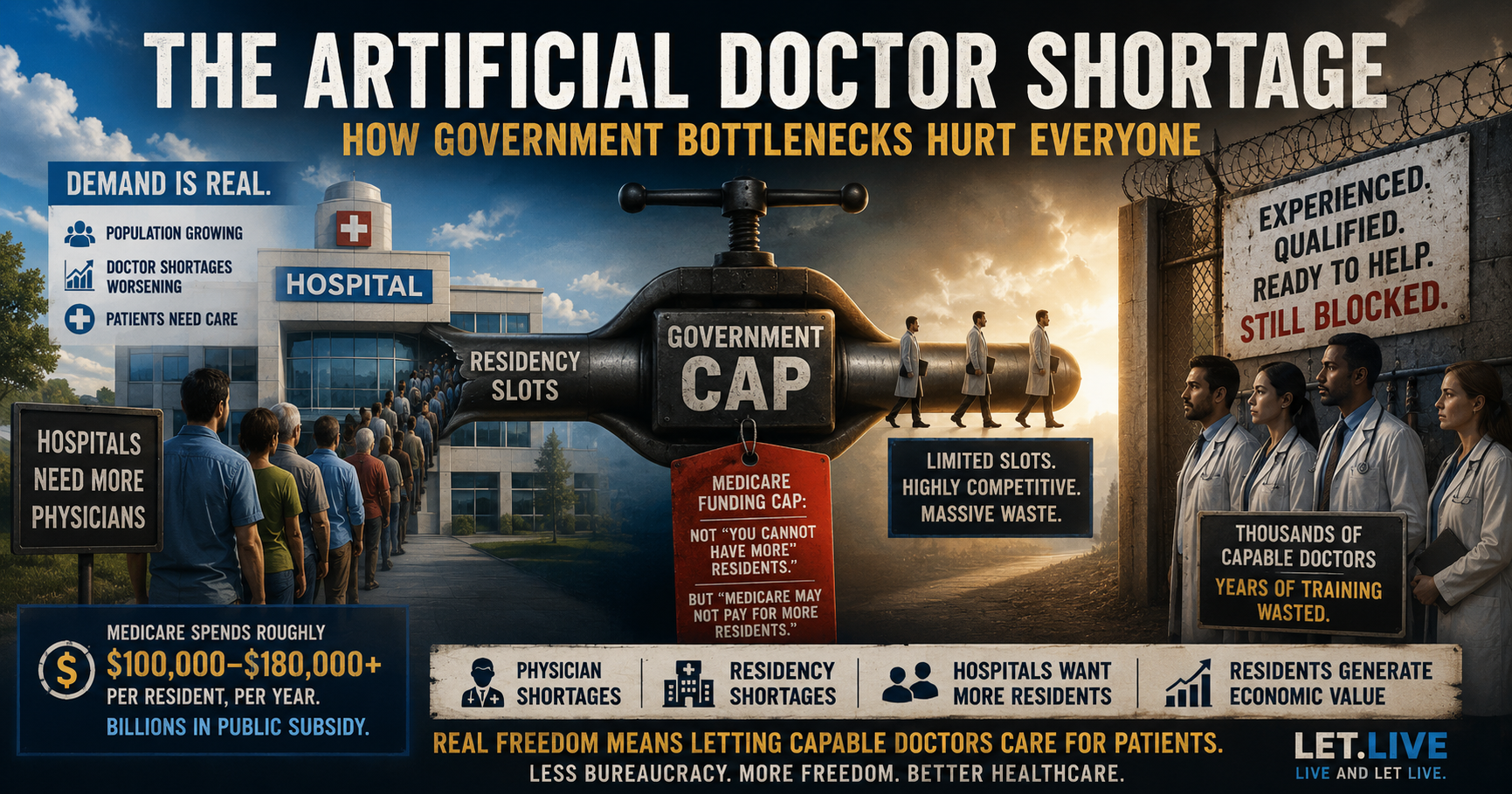
The problem is that residency positions are heavily tied to Medicare funding, and Congress effectively capped many Medicare-funded residency slots decades ago.
Since then:
- The U.S. population has grown dramatically
- Demand for healthcare has surged
- Physician shortages have worsened
- Hospitals need more doctors than ever
But residency growth has not remotely kept pace.
The result is an artificial bottleneck that limits the supply of physicians entering the workforce.
The Strange Contradiction
The current system produces a bizarre and self-destructive reality:
- Hospitals desperately need physicians
- Patients desperately need care
- Highly qualified foreign doctors want to practice
- Residency programs remain constrained
- Existing residents generate economic value
- Taxpayers already spend billions subsidizing training
Yet experienced physicians from other countries are often forced through years of redundant retraining—or blocked entirely.
This is not a natural market outcome. It is a government-created scarcity.
The Medicare Funding Distortion
One of the most misunderstood aspects of this system is the role of Medicare funding.
Roughly speaking, Medicare funding per resident often falls somewhere around:
$100,000–$180,000+ per resident per year
This funding helps hospitals offset training costs. But here’s the critical point many people miss:
The Medicare cap is NOT:
“You cannot have more residents.”
The Medicare cap IS:
“Medicare may not pay for more residents.”
That distinction matters enormously.
Hospitals are legally allowed to create additional residency positions. The government is not physically preventing them from doing so.
But because healthcare is already heavily distorted by regulation, reimbursement systems, and administrative burden, many hospitals cannot realistically afford to expand residency programs without federal subsidy.
So Congress effectively created a financial choke point that now functions as a gatekeeping mechanism for the entire physician pipeline.
Artificial Scarcity Always Hurts Ordinary People
At Let.Live, we consistently warn about the dangers of artificial scarcity created through centralized control.
Whether it’s housing, education, energy, or healthcare, restricting supply almost always produces the same outcomes:
- Higher costs
- Reduced access
- Longer waits
- Greater inequality
- Increased bureaucracy
- Concentration of institutional power
Healthcare is no exception.
The residency bottleneck does not protect patients from bad doctors. America already has licensing exams, malpractice systems, board certifications, peer review, and hospital credentialing.
Instead, the bottleneck primarily limits supply.
And whenever supply is artificially constrained while demand rises, the result is predictable:
scarcity.
The Human Cost
The victims of this system are not abstract statistics.
They are:
- Rural communities with no specialists
- Patients waiting six months for appointments
- Overworked physicians burning out
- Emergency rooms handling non-emergency care
- Immigrants who were practicing doctors overseas but now drive for Uber because they cannot navigate America’s residency bottleneck
America simultaneously has:
- physician shortages
- residency shortages
- hospitals wanting more residents
- residents generating economic value
- billions in public subsidy
This contradiction should force us to ask:
Is the system actually designed to maximize healthcare access—or to preserve institutional gatekeeping?
A Let.Live Approach
A free society should focus on empowering patients and physicians—not preserving artificial barriers.
That could include:
- Expanding independent residency funding models
- Allowing hospitals greater flexibility
- Creating accelerated pathways for experienced foreign-trained physicians
- Reducing unnecessary administrative barriers
- Allowing market competition in physician training
Most importantly, it requires recognizing that centralized systems often create the very shortages they later claim only more centralization can solve.
Conclusion: Trust People More Than Bureaucracies
The healthcare system should exist to serve patients—not perpetuate bottlenecks.
America does not lack intelligent, capable people willing to become doctors. It lacks a system willing to allow them to practice.
At Let.Live, we believe liberty means trusting individuals more than bureaucratic gatekeeping systems. When government intervention artificially limits opportunity, everyone suffers—especially ordinary people who simply need care.
The physician shortage is not entirely natural.
Much of it was engineered.
And what government policy helped create, better policy can help undo.
Comments are closed