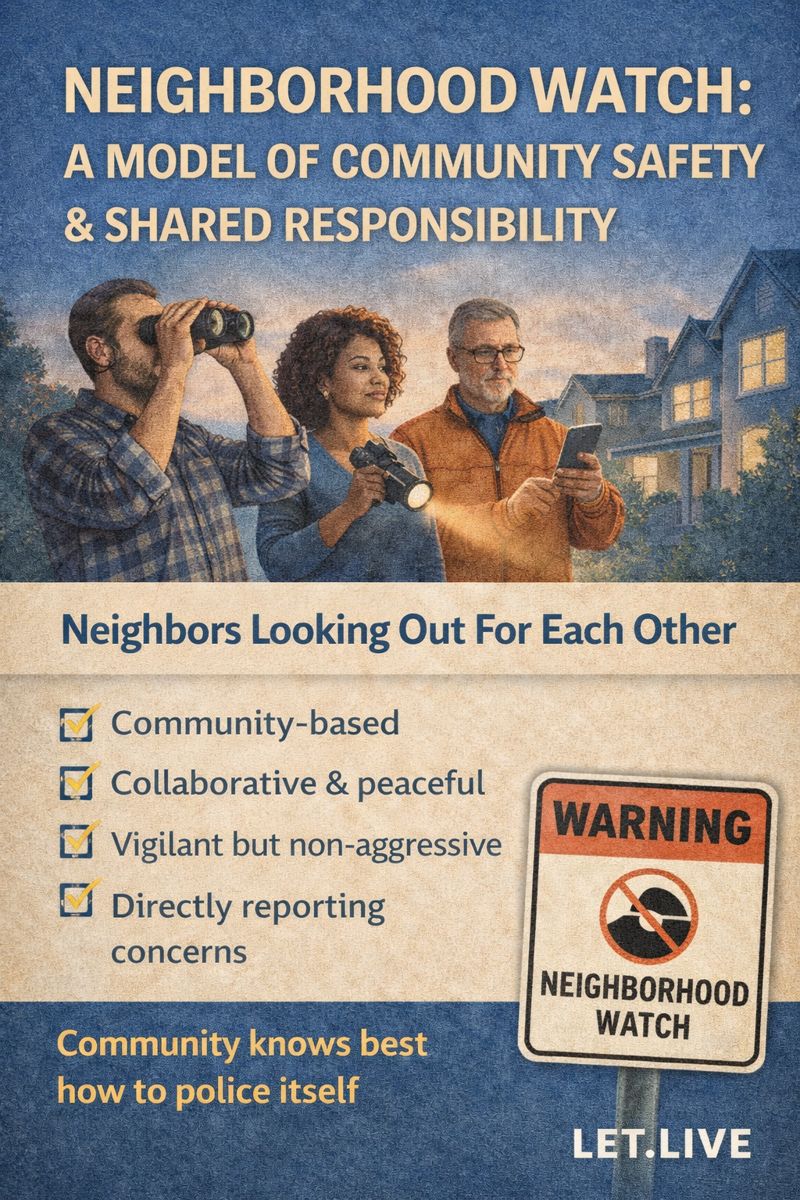
Neighborhood Watch: A Model of Community Safety and Shared Responsibility
In Minnesota and cities across the U.S., news reports show protesters and federal immigration agents clashing in the streets after fatal shootings involving ICE and Border Patrol agents. The tragic deaths of Renee Good and Alex Pretti, both U.S. citizens killed during federal enforcement operations in Minneapolis, have fueled widespread gatherings, outrage, and calls for accountability. The presence of federal agents and law enforcement actions in local neighborhoods has heightened tension and anxiety in communities across the state. (Wikipedia)
Amid these fraught discussions, one phrase has begun circulating in activist circles: “neighborhood watch.” But what is a neighborhood watch? And why is it worth elevating as a positive—and constitutionally grounded—model for community safety?
What Is a Neighborhood Watch?
At its simplest, a neighborhood watch is exactly what its name suggests: neighbors watching out for one another. Historically, citizens in a community come together—voluntarily—to observe their surroundings, look out for signs of crime, support each other in emergencies, and act as an early warning system. Neighbors talk to one another, share observational information, and call appropriate authorities when something is amiss.
The etymology of the phrase is straightforward: “neighborhood” refers to the people living in a shared geographical area, and “watch” implies vigilant observation—not aggression, not enforcement, not vigilantism. It derives from the idea that community members who know one another well are often best positioned to notice when something is wrong and to act in ways that preserve safety.
A Sign of a Healthy Community—Not an Unsafe One
Some assume that the presence of a neighborhood watch signals an unsafe area. But in truth, a neighborhood watch exists because a community cares about its safety and the well‑being of its residents. When neighbors organize, communicate, and cooperate, they are demonstrating agency, mutual concern, and collective responsibility. That’s the opposite of chaos—it’s shared stewardship of public space.
The original concept is not about taking law enforcement into your own hands. It’s about:
- Being aware of your environment
- Looking out for each other’s welfare
- Reporting unusual activity
- Deterring crime through community cohesion
- Helping neighbors in times of emergency
Neighborhood Watch vs. Mischaracterized Tactics
In the current climate, the word “protest” can be loaded—triggering images of chaos, confrontation, or violence. In contrast, “neighborhood watch” evokes something different: collective care, communication, and cooperation across lines of fear and suspicion. It is a term that suggests community presence, not riotous behavior. It emphasizes peaceful observation and mutual protection—not hostility or enforcement.
The people who are showing up around ICE operations aren’t protestors. They aren’t demonstrators who travelled. They are mostly people in their own town, showing up for their neighbors. A neighborhood watch isn’t a tactic; it’s a principle: neighbors taking mutual responsibility for the well‑being of their community.
Community Knowing How to Police Itself
At Let.Live, we believe in decentralizing power away from coercive authority when possible and empowering individuals and communities to act responsibly together. A neighborhood watch is fundamentally different from vigilantism—it does not assume the right to arrest or punish, but does assume the responsibility to observe, report, assist, and communicate.
Neighborhood watches reflect:
- Human connection
- Mutual respect
- Shared accountability
- Active citizenship
When a community knows how to watch over itself—when people see one another as neighbors rather than outsiders—that community becomes more resilient, more empathetic, and more effective at keeping itself safe without harming civil liberties or individual rights.
Conclusion: A Return to Shared Responsibility
In times of heightened tension, fear, or distrust—like those Minnesota is experiencing today—when people feel disconnected from institutions or threatened by federal power, it’s easy to default to polarized language. But the principles of neighborhood watch remind us of something deeper: the first line of safety and security is neighbor to neighbor. Not government enforcement. Not violence. Not division.
A strong community doesn’t wait for someone else to create safety. It builds it from within—together.
Comments are closed