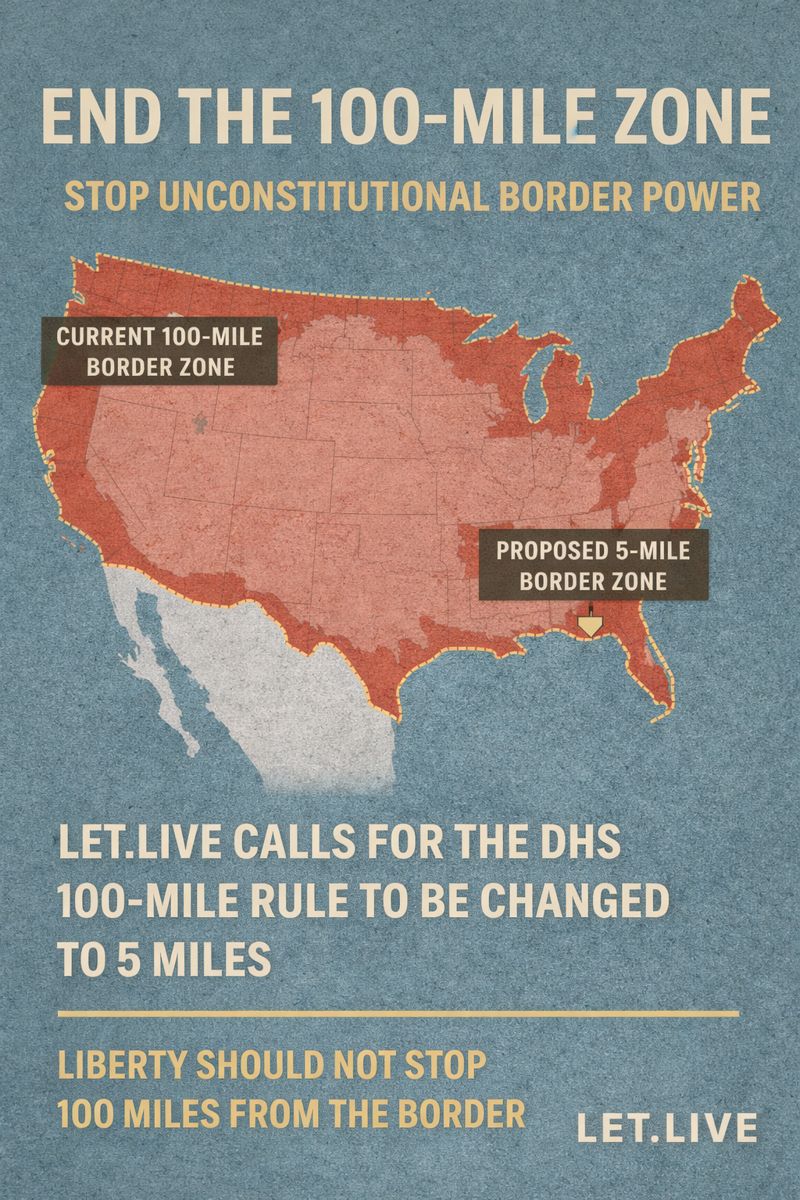
Let.Live believes in liberty, due process, and equal protection under the law. These principles do not dissolve within 100 miles of the U.S. border—but under current regulations, they might as well.
In the wake of the tragic killing of Renee Nicole Good, shot by a Border Patrol officer in Minneapolis, it’s time for Americans to confront an uncomfortable truth: much of the country exists in what is effectively a Constitution-lite zone, where civil liberties are subject to erosion not by Congress, but by executive decree.
The 100-Mile Rule: A Bureaucratic Overreach
The so-called “100-mile rule” comes not from legislation passed by Congress, but from a regulation: 8 C.F.R. § 287.1, written and enforced by the Department of Homeland Security. This rule authorizes Customs and Border Protection (CBP) to operate with expanded authority—such as conducting stops and searches without a warrant—within 100 miles of any U.S. border or coastline.
This may sound like a narrow perimeter, but roughly two-thirds of the U.S. population lives within it, including residents of cities like New York, Chicago, Los Angeles, and yes—Minneapolis.
It is critical to understand that this was not debated or voted on by our elected representatives. This sweeping power was granted through regulation—a rule written by unelected officials, and applied without geographic or demographic discretion.
A Tragic Cost: Renee Nicole Good
The death of Renee Nicole Good in Minneapolis brings the issue home in the starkest possible terms. She was nowhere near an international border, yet fell victim to an agency acting under border enforcement authority.
We don’t yet know every detail, but we do know this: Border Patrol is not a local police force, nor was this area under imminent threat from cross-border criminal activity. When a national security agency exercises lethal force hundreds of miles from its jurisdictional rationale, we must stop and ask: Where is the line?
Liberty Has Limits—And So Should Power
The Let.Live principle of limited government holds that no arm of the state should operate with unbounded authority. Even in matters of national security, liberty cannot be endlessly sacrificed for control. The 100-mile rule blurs the line between immigration enforcement and domestic policing, allowing the federal government to act with fewer constitutional constraints in areas where millions of people live, work, and raise families.
If DHS needs tools to protect the border, let them argue for them through Congress—not through quiet regulation that bypasses the democratic process.
A Reasonable Proposal: Shrink the Zone
Let.Live calls for an immediate revision by Congress of 8 C.F.R. § 287.1 to reduce the CBP’s expanded authority zone from 100 miles to 5 miles. This would:
- Protect true border operations without inviting federal overreach
- Reinforce the distinction between immigration enforcement and domestic law enforcement
- Honor the Fourth Amendment, which guards against unreasonable searches and seizures
A Future Rooted in Consent, Not Fear
Let.Live believes in a government of, by, and for the people—not one that governs from the shadows of bureaucratic regulation. The fact that millions of Americans live under reduced civil protections, not by law but by rule, is an affront to the Constitution.
This isn’t just a border issue. It’s a liberty issue. And liberty should not shrink the closer you live to the coast.
Let this be the moment we say: Enough. Shrink the zone. Restore the balance. Honor the Constitution.
Comments are closed