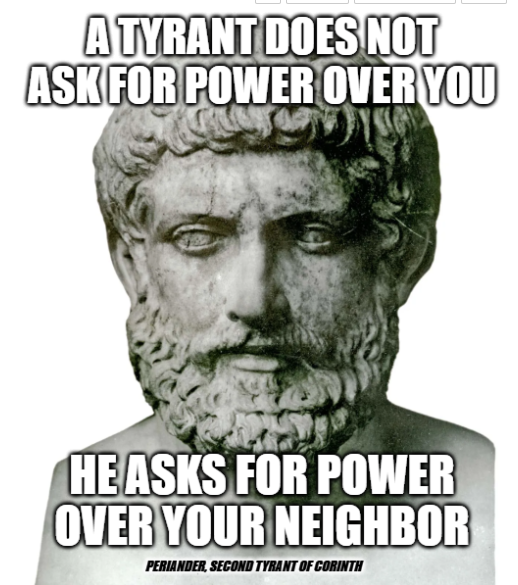
One of the most important truths about political systems is often overlooked: political power is a closed system. Government does not create power out of nothing. Every authority it exercises is authority that has been delegated by the people — or taken from them. When government power grows, individual liberty necessarily shrinks. And when people reclaim power, government must yield it.
This reality explains why nearly every major abuse of authority in history began with powers that were granted for noble reasons. Emergencies, economic crises, wars, and social movements frequently inspire calls for expanded authority — always with the promise that the new powers will be used responsibly. Yet once granted, those powers rarely disappear. They simply become part of the permanent machinery of the state.
Science fiction author Robert A. Heinlein captured the underlying principle well when he wrote:
“Political tags — such as royalist, communist, democrat, populist, fascist, liberal, conservative, and so forth — are never basic criteria. The human race divides politically into those who want people to be controlled and those who have no such desire. The former are idealists acting from highest motives for the greatest good of the greatest number. The latter are surly curmudgeons, suspicious and lacking in altruism. But they are more comfortable neighbors than the other sort.”
— Robert A. Heinlein, Time Enough for Love
Heinlein’s insight reminds us that the greatest dangers to liberty do not always arise from malicious intent. More often, they arise from the sincere belief that giving authorities “just a little more power” will allow them to solve pressing problems. But each new authority represents a transfer of freedom from the individual to the institution.
Corporations, too, illustrate this same principle. Corporations do not possess inherent political power; they exercise powers that governments have granted through law, regulation, and charter. And governments themselves possess only the authority that people have either explicitly granted or failed to resist losing. Political authority flows downward — from individuals to institutions — not the other way around.
This is why expanding liberty cannot be achieved merely by demanding that government act differently. If we truly want people to hold more power over their own lives, that power must be taken back from government — because government cannot hold more authority without individuals holding less. Political freedom is not an abstract idea; it is the literal space in which individuals are allowed to act without permission.
The principles of Let.Live — consent culture, tolerance, and acceptance of change — depend on recognizing this balance. A tolerant society is not one where officials are empowered to engineer behavior for the public good, but one where individuals retain the widest possible sphere of voluntary choice. Every time a new regulatory authority is created, a new surveillance power granted, or a new enforcement mechanism authorized, some measure of personal autonomy is exchanged for centralized control.
This does not mean government has no legitimate role. It does mean that every expansion of authority should be treated as a serious trade, not a symbolic gesture. The question is never simply whether a policy aims to accomplish something good. The deeper question is: What freedom are we giving up in exchange, and will we ever get it back?
History shows that power accumulates far more easily than it recedes. A society that wishes to remain free must therefore cultivate a constant awareness that liberty is not preserved by good intentions, but by maintaining limits — limits that ensure no institution can quietly gather authority at the expense of the people it claims to serve.
If we want a future where individuals truly hold more control over their lives, the path is clear: power must flow back toward the people, because every increase in personal freedom necessarily requires a decrease in the power exercised over them.
Comments are closed